

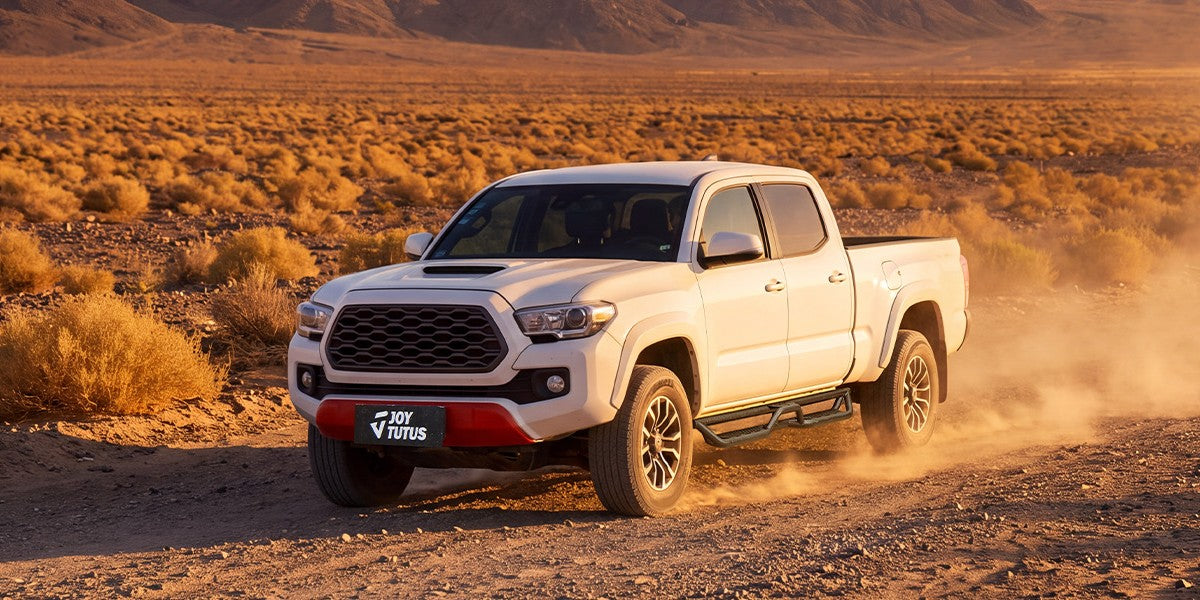
If you own a Toyota Tacoma, you already know the truck is built for adventure. Whether you are hauling gear to a campsite, driving the family out on a weekend trip, or just using it as your daily workhorse, the Tacoma does a lot. But there is one thing many owners overlook until they really need it: getting in and out.
Tacoma trucks sit higher off the ground than most passenger vehicles. That gap might not seem like a big deal when you are young and agile, but bring along a child, an older parent, or a full load of passengers, and suddenly that climb becomes an obstacle. This is exactly where Tacoma running boards come in.
In this guide, we will cover everything you need to know before buying.
Why Tacoma Owners Consider Running Boards
Toyota Tacoma running boards are one of the most popular truck accessories for a reason. The Tacoma's ground clearance is a selling point off the road, but it creates a real inconvenience in everyday situations. Stepping up into the cab from a parking lot, loading a child into the back seat, or reaching items on the roof rack can all feel awkward without a proper step to help.
Running boards sit along the lower sides of the truck and create a stable platform between the ground and the door sill. That single addition makes a noticeable difference in how accessible your truck feels, day in and day out.
3 Things to Look for in Toyota Tacoma Running Boards
Not every running board is worth buying. The range of quality out there is wide, and the wrong choice means a board that looks fine for a season before it rusts, flexes underfoot, or becomes slippery when wet. Here are the three features that matter most.
Durability and Weather Protection for Tacoma Side Steps
Running boards live outdoors every single day. They take rain, road salt, mud, and direct sun through every season. That means the material and finish are just as important as the shape of the board itself.
A reliable running board for Toyota Tacoma use should be made from heavy-gauge steel or aluminum that carries real weight without bending or creaking underfoot. It should also be rated for the kind of load you might put on it, whether that is a single adult stepping up or a child and a bag of gear at the same time.
Corrosion protection is where cheap boards tend to fail first. A single-coat finish chips, moisture gets underneath, and rust spreads quickly. The better option is a multi-layer coating system that seals every surface against oxidation and UV damage. Qualified running boards should be used with a three-layer coating process built for long-term protection in all weather conditions so the finish holds up season after season.

Anti-Slip Steps That Work in Any Weather
A running board without proper grip is genuinely dangerous. A wet, smooth metal surface gives you almost nothing to hold onto, and that is exactly the moment when you most need a secure footing — stepping out of the truck in the rain after a hike or helping a child climb in during a cold, damp morning.
The step surface needs texture. Raised tread patterns on quality Toyota Tacoma side steps push water away from the surface and give your boot sole something to grip. The difference between a textured pad and a bare metal surface is not subtle; you feel it immediately in your confidence stepping up.
Dual-Tube Step Design for Families and Active Use
Single-step running boards work for one height. The Tacoma's cab floor is high enough that a single step still leaves a significant gap for shorter passengers, and it does nothing to help you reach gear loaded on a roof rack.
A dual-tube step design handles both situations. The lower tier gives smaller passengers an easy first landing before stepping up to the cab. The upper tier then closes the remaining gap to the seat. For anyone who regularly loads or unloads a rooftop carrier, that second level also provides the height to safely reach overhead without overreaching or standing on a wheel arch.
This two-stage format has become popular among buyers looking for running boards for Toyota Tacoma trucks precisely because it fits how real families and overlanders actually use their trucks, not just how a single adult commuter does.
Who Benefits Most from Tacoma Side Steps
Running boards are one of those upgrades that almost every Tacoma owner notices in daily use. A few groups benefit especially clearly.
- Families with young children: Kids do not have the leg length to climb into a lifted truck cab on their own. A lower first step changes the whole experience and removes the need to physically lift a child into their seat on every outing.

- Older passengers or anyone with limited mobility: A step-up that requires strength and flexibility creates real discomfort on longer travel days. A solid intermediate step removes that barrier entirely.
- Overlanders and campers: If you spend weekends on trails, you are getting in and out of the cab repeatedly, loading gear from the bed, and sometimes parking on uneven ground. Running boards add stability and convenience in those situations.
- Daily commuters: Even in routine use, stepping up confidently rather than hauling yourself into the seat is a noticeably better experience that adds up over time.
If your Tacoma is a solo work truck, off-roading machine, and passengers are rare, you could also see it as a nerf bar to protect your doors. For most owners, especially anyone hauling family or hitting trails on weekends, they are one of the more practical upgrades available.
Running Boards vs Side Steps vs Nerf Bars
These names overlap, and shoppers use them interchangeably, but they point to slightly different products. Knowing the difference keeps you from buying the wrong one.
|
Term |
What it usually means |
Best for |
|
Running boards |
Full-length boards that run along the door opening |
Easy entry for every passenger |
|
Side steps |
Shorter or individual steps placed at the doors |
Getting in with a smaller footprint |
|
Nerf bars |
Round or oval tubes along the lower body |
Door protection, with some stepping use |
|
Power running boards |
Motorized boards that extend when a door opens |
Convenience, at higher cost and complexity |
The Joytutus running boards covered here are fixed running boards that also act as a nerf bar, adding a buffer along the lower door panels that reduces dings and scratches in tight spaces. If you are weighing fixed against motorized, read Power vs. Fixed Running Boards.
Which Running Boards Fit Your Tacoma?
Joytutus currently makes Tacoma running boards for the Double Cab (the four-door body, sometimes listed as Crew Cab) in two model-year ranges. Check your cab and year before you order, because boards made for one generation will not bolt onto another.
|
Your Tacoma |
Joytutus running boards |
Where to buy |
|
2024-2026 Double Cab (4 doors) |
Available |
|
|
2005-2023 Double Cab (4 doors) |
Available |
|
|
Xtra Cab, Access Cab or Regular Cab |
Not currently offered |
Keep an eye on Tacoma accessories |
Not sure which cab you have? Count the full-size doors. Four doors that open on their own hinges means Double Cab; two full doors with small rear-hinged doors or no rear seat doors means a different cab.
Final Thoughts
Running boards are not a flashy upgrade, but they are one of the most consistently useful ones you can add to a Toyota Tacoma. The truck's height is an asset on the trail and a minor inconvenience everywhere else. A well-chosen set of Tacoma side steps handles that inconvenience permanently and adds door protection as a bonus.
When you shop, focus on three things: corrosion-resistant construction, properly textured anti-slip steps, and a dual-tube design that works for everyone in your truck. Get those right and you end up with running boards that earn their place every single day.
Ready to choose? Explore the full range of running boards for other trucks.
FAQ
Q1: Will these running boards fit my Tacoma?
Joytutus makes boards for the 2024-2026 Tacoma Double Cab and the 2005-2023 Tacoma Double Cab, both four-door bodies. They do not fit Xtra Cab, Access Cab or Regular Cab trucks. Use the fitment table above to pick the right pair.
Q2: Is a Tacoma Double Cab the same as a Crew Cab?
Yes. Double Cab is Toyota's name for the four-door crew-cab body, so boards listed for either name fit the same truck.
Q3: Do I need to remove my factory rock rails or side steps?
Yes. Remove any factory rock rails or side steps before installing the 2024-2026 boards.
Q4: Are running boards the same as nerf bars?
Not exactly. Nerf bars are tubular rails that mainly protect the lower body. Running boards add a flatter stepping surface, and these boards also give the door panels a nerf-bar-style buffer.


Leave a comment
All comments are moderated before being published.
This site is protected by hCaptcha and the hCaptcha Privacy Policy and Terms of Service apply.